Grow Guides · Hydroponics Basics

pH for Hydroponics: How to Test and Adjust It

November 6, 2026· 8 min read· 0 comments

pH measures how acidic or alkaline a nutrient solution is, and in hydroponics it decides how well roots can take up what you mixed. It is the first thing to check when a healthy-looking mix still gives a slow plant.

Soil buffers pH, but water and nutrient solutions do not, so the reading can move from day to day as plants drink. A quick test and a small adjustment keep it steady.

Quick answer
pH tells you how acidic or alkaline the nutrient solution is. Many hydroponic growers aim for a mildly acidic range, often around 5.5 to 6.5, but the label of your nutrient and the needs of your plant win. Test the solution after mixing, add pH Down to lower it or pH Up to raise it, and recheck.
pH for Hydroponics: How to Test and Adjust It
The label wins

A general range is a starting point. Your nutrient label and your plant's needs set the real target, so follow them when they differ from a number you have read.

Adjust a little at a time

Concentrated pH products work in tiny amounts. Add a small measure, stir, give it a moment, and test again before adding more.

Two directions

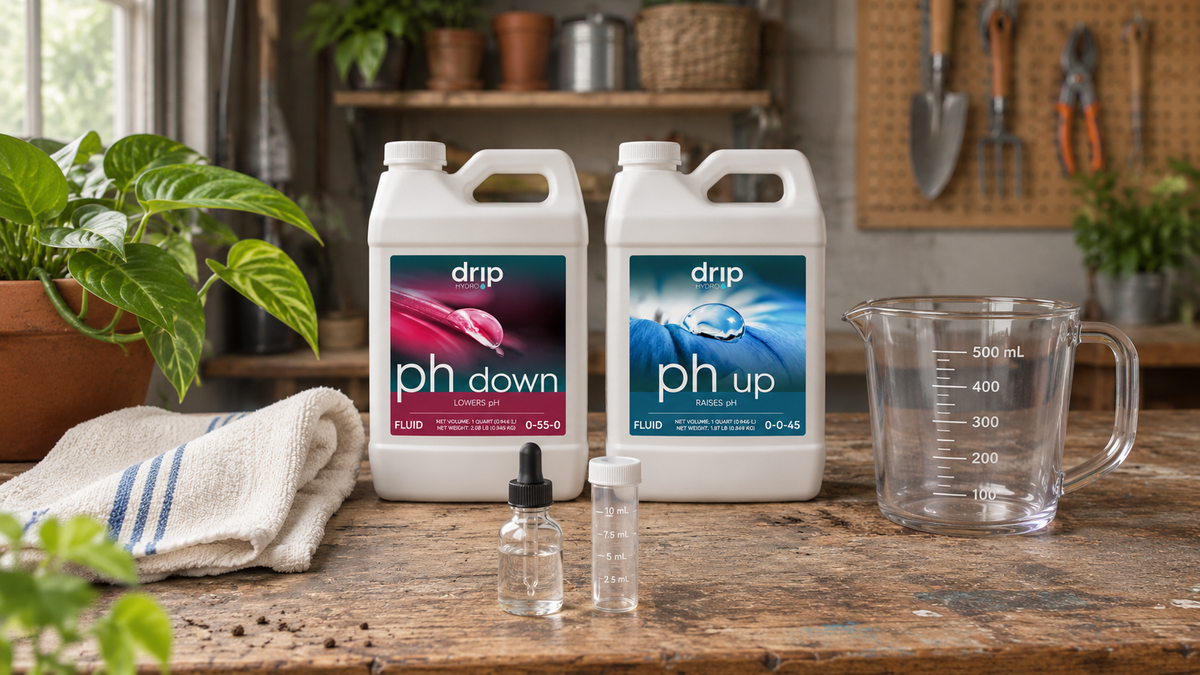
pH too high or pH too low.

One raises the reading and one lowers it, so the direction it has moved tells you which to reach for.
pH is too high
pH is too low
What you use
A pH Down product, which lowers the pH of the solution.
A pH Up product, which raises the pH of the solution.
Common cause
Hard or alkaline source water, or some nutrient mixes drifting upward as plants feed.
Heavy feeding, or acidic nutrient mixes pulling the solution lower over time.
What you may see
Pale new growth and slow plants, even with plenty of nutrients in the water.
Stunted, discolored growth, with roots that may look dull or stressed.
How to correct
Add a very small amount of pH Down, stir, and test again.
Add a very small amount of pH Up, stir, and test again.
Symptom checker

I see this in my system.

Pick the reading or plant sign that sounds like yours, and start with the change listed beside it.
Symptom
Likely cause
Quick fix
Severity
Pale or yellowing new growth, though the nutrient mix is correct
pH may have drifted out of range, so roots cannot take up nutrients that are already in the water.
Test the solution with a drop kit, bring it back toward your label's range with a small pH adjustment, and recheck after a few hours.
High
Slow growth and weak roots in a new system
The starting solution was never tested, or the source water carries a pH that suits the plant poorly.
Test the water before adding nutrients, mix, then test and adjust the finished solution.
High
pH reading keeps climbing between checks
Plants are drinking and feeding, and the solution is drifting. Hard source water can also push the reading up.
Check more often, adjust in small steps, and refresh the solution on the label schedule.
Medium
pH reading keeps dropping between checks
Feeding and root activity can pull the solution lower, especially in a small reservoir.
Test regularly, raise it gently with a small amount of pH Up, and consider a larger reservoir.
Medium
The pH reading jumps right after adding a nutrient
Many nutrient products change the solution's pH as they dissolve, so a reading taken before mixing is out of date.
Mix the nutrients fully first, then test and adjust the finished solution.
Medium
Test results are hard to read or do not match each other
A drop-test color chart can be hard to judge, and an uncalibrated meter can read off.
Test in good light against the color chart, and follow the instructions for any meter you use.
Low
Why pH keeps drifting

Testing habits that keep pH out of range.

Timing and amount are behind each of these.

Common beginner mistakes
No.
Mistake
What goes wrong
The fix
Severity
01
Testing before the mix is finished
✕Reading pH on plain water, then adding nutrients that shift it, so the final solution is never checked.
✓Mix the nutrients first, then test the finished solution.
Most common
02
Adding too much at once
✕Pouring in a large measure of pH Up or pH Down, which can overshoot and send the reading the other way.
✓Add a very small amount, stir, wait, and test again.
Common
03
Testing once and never again
✕Assuming pH stays where it was set, even as plants drink and feed over the following days.
✓Recheck every few days and after any top-up.
Underrated
Key takeaways

pH habits worth keeping.

  1. 01pH controls how well roots can take up the nutrients in the solution.
  2. 02Many hydroponic growers aim for a mildly acidic range, and the label of your nutrient wins.
  3. 03pH Down lowers the reading and pH Up raises it, both in very small amounts.
  4. 04Test after the nutrients are fully mixed, then again every few days.
  5. 05A pale plant with a correct mix is a good reason to check pH first.
Discussion

Questions or notes? Drop them here.

A real grower replies within a business day.

No comments yet. Be the first.

FAQ

Common questions about hydroponic pH.

Many growers aim for a mildly acidic range, often around 5.5 to 6.5. The label of your nutrient and the needs of your plant come first.
Plants take up water and nutrients unevenly, and some nutrient products shift pH as they dissolve. Hard source water can also move the reading.
Both Drip Hydro products on this page are listed as needing only 0.25 to 1 mL per adjustment. Add a small amount, stir, test, and repeat if needed.
After you finish mixing a solution, and again every few days. Test after any top-up too, since added water or nutrient can move the reading. A drop kit like the one listed here reads 4.0 to 10.0.
It does, but soil buffers changes more than water does. In a hydroponic system the solution is the root zone, so pH needs closer attention.
The promise

Grow better. Eat better. Every day.

Your partner in every harvest. Test the finished mix, add a small measure of adjuster if the reading needs it, and test again.

Posted November 6, 2026 · Updated November 6, 2026 · 8 min read